Hidden Water Leak Detection in Ewing, NJ
Pinpoint pressurized water leaks hidden behind walls, under subflooring, and inside ceilings without destructive demolition. Reliable non-invasive diagnostics for Ewing homeowners.
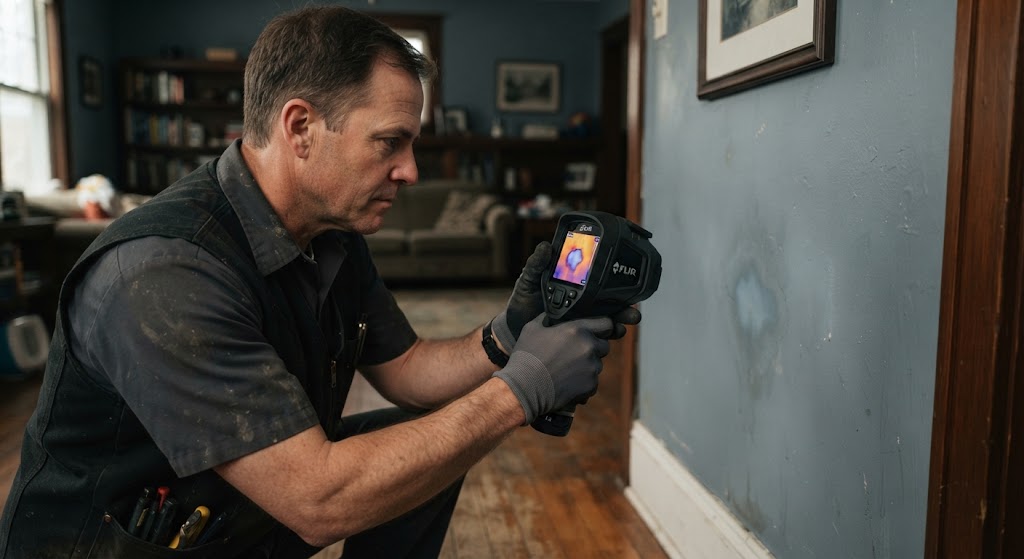
Pinpoint Concealed Leaks in Ewing Homes Without Demolition
Concealed water leaks present one of the most frustrating maintenance challenges for residential property owners in Ewing, New Jersey. With much of the local housing stock built during the post-war building boom of the 1940s through 1960s, copper and galvanized supply pipes have reached the end of their operational lifecycle. When these pipes develop hairline fractures, water does not always cascade into living areas; it often seeps quietly inside framing cavities, soaking fiberglass insulation, staining drywall, and weakening structural timber.
Whether you reside in West Trenton, Prospect Heights, or near The College of New Jersey, dealing with a suspected leak behind wall Ewing situation requires precise diagnostic instruments. Guesswork leads to broken plaster, wrecked trim, and unnecessary repair expenses. Our approach focuses on non-invasive water leak detection Ewing NJ methods that locate the exact position of hidden pipe breaches before a single wall is opened.
If you have received an unexpected high water bill leak Ewing NJ notice or hear the faint sound of running water when all faucets are shut off, non-destructive pinpointing provides definitive answers.
Common Warning Signs of Hidden Water Leaks
- Unexplained jump in municipal water charges without increased household use
- Water meter leak indicator spinning while all fixtures and appliances are turned off
- Spongy drywall, bubbling paint, or discoloration along baseboards and ceilings
- Musty, damp odors trapped within enclosed rooms or closets
- Localized warm spots on hardwood, linoleum, or concrete slab floors
- Faint hissing, whistling, or trickling sounds inside interior partition walls
Why Concealed Pipe Leaks Occur in Ewing's Housing Stock
Ewing's architectural history and seasonal New Jersey weather patterns create unique stresses on domestic plumbing systems:
Aging Copper & Galvanized Plumbing
Homes constructed in the 1950s in neighborhoods like Prospect Heights and Ewingville feature original copper piping and galvanized fittings. Decades of mineral friction, localized galvanic reactions, and water chemistry cause internal pitting corrosion that results in pinhole leaks.
Seasonal Freeze-Thaw Ground Shifts
Mercer County winters bring severe freeze-thaw cycles. Soil contraction and frost heaves stress foundation entry points, causing subterranean supply lines and slab-routed pipes to flex, crack, or pull apart at sweat-soldered joints.
High Municipal Water Pressure
Properties along Route 31 and near regional pumping stations often experience elevated municipal water pressure. Pressure spikes place continuous strain on aging shut-off valves, fixture supply lines, and internal pipe elbows.
Suspecting a Hidden Pipe Leak in Ewing?
Get your plumbing lines tested non-invasively before moisture damages structural framing or drywall.
Our Step-by-Step Hidden Leak Detection Process
We deploy advanced non-destructive technology to map moisture paths and locate concealed water leaks with mathematical precision:
Pressure Decay Testing
We attach precision digital pressure gauges to your plumbing branches to determine whether the domestic hot or cold water supply is losing volume, isolating the affected circuit.
Acoustic Sensor Mapping
Escaping pressurized water generates ultrasonic and high-frequency sound signatures. Our ground microphones and acoustic listening discs filter out ambient noise to isolate the exact source behind walls or floors.
Infrared Thermal Imaging
High-resolution thermal cameras capture surface temperature differentials caused by warm water plumes or evaporative cooling, visualizing the moisture footprint behind drywall.
Moisture Mapping & Tracer Gas
Calibrated radio-frequency moisture meters map the saturation boundary. When necessary, inert tracer gas is introduced to pinpoint microscopic leaks under concrete slab foundations.
What Happens After the Leak Is Pinpointed
Once our specialists complete the diagnostic phase, you receive an exact physical marking of the breach on the wall or floor, accompanied by an objective inspection summary. Because we pinpoint the leak to within inches, a plumber can make a minimal surgical opening to perform the repair, saving thousands of dollars in drywall, paint, or flooring reconstruction.
Repair options typically include localized pipe section replacement, installing high-grade copper sleeves, or bypassing an obsolete supply line. For homeowners with extensive corrosion throughout a single branch, our diagnostic findings provide clarity on whether a localized fix or broader repiping is the most prudent long-term strategy.
Cost factors for resolving a leak depend on pipe accessibility, pipe material (copper, PEX, or galvanized), and whether the rupture is inside an interior partition wall, behind bathroom tile, or beneath a concrete slab. Precision leak detection removes the expensive guesswork from the equation.
Prevention Tips for Hidden Pipe Leaks
- Install a pressure-reducing valve (PRV) to maintain household water pressure below 65 PSI
- Inspect water heater and washing machine braided supply hoses every two years
- Insulate exposed piping in crawl spaces and exterior-facing walls before freezing winter weather
- Conduct a monthly water meter check when all household water outlets are idle
Note: All permanent plumbing repairs in New Jersey must be performed by a licensed NJ master plumber.
When a Hidden Leak Becomes an Emergency
A concealed leak can quickly turn into an emergency if water begins dripping through electrical fixtures, causing ceilings to sag noticeably, or wetting basement electrical panels. If you notice signs of structural saturation, shut off your home's main water valve immediately. In any emergency situation where water is actively flowing, rapid pinpointing prevents catastrophic mold remediation and extensive reconstruction.
Hidden water leaks are particularly common in older neighborhoods across Ewing, including West Trenton, Prospect Heights, and Ewingville, where 1950s metallic plumbing lines are common. Connect with our diagnostic team to protect your home before minor leaks cause catastrophic damage.
Speak Directly With an Ewing Leak Specialist
Describe what you are seeing and schedule a non-invasive acoustic and thermal inspection today.
Related Leak Detection Services in Ewing
Explore our complete range of non-destructive diagnostic solutions for residential and commercial properties:
Basement Leak Detection
Determine whether basement moisture is caused by foundation groundwater infiltration or a leaking domestic supply line behind drywall.
Pipe Leak Repair
Pinpoint corroded copper lines, failed fittings, and pinholes so licensed plumbers can perform targeted pipe section replacements.
Water Line Leak Detection
Locate underground service lateral leaks between the municipal street shut-off and your home foundation without trenching.
Learn more about our local work on our leak detection in Ewing overview, or check out our complete list of Ewing leak detection service areas.
Frequently Asked Questions About Hidden Leak Detection
Pressurized water escaping through a pipe rupture creates distinctive sound frequencies. Our specialized acoustic sensors and ground microphones capture these vibrations through drywall and plaster, allowing technicians to locate the breach without cutting walls.
Yes. While hot water leaks display elevated thermal plumes, cold water leaks create subtle evaporative cooling patterns that alter wall surface temperatures. High-resolution infrared cameras detect both thermal variations clearly.
A sudden spike in water bills usually points to an active continuous leak in a concealed copper or galvanized supply line, a leaking toilet flapper, or a broken underground line running beneath the basement floor.